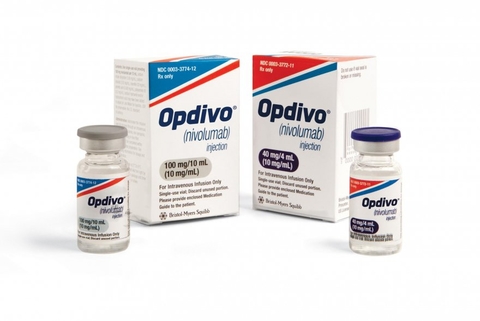
Bristol-Myers Squibb had been hoping to challenge Nexavar, Bayer's long-standard therapy for hepatocellular carcinoma, in newly diagnosed patients. (BMS)
BARCELONA—Bristol-Myers Squibb’s blockbuster immunotherapy Opdivo flunked its first-line liver cancer test, but to hear the studys lead author talk, it was just a technical failure.
In the CheckMate 459 study, presented here at the European Society for Medical Oncology (ESMO) Congress, Opdivo may not have hit its primary goal—helping previously untreated liver cancer patients live longer—but it did deliver improvements worth noting, said study author Thomas Yau, M.D., of the University of Hong Kong.
For instance, Opdivo beat Bayers Nexavar, the current standard of care, when it came to complete response rate, Yau noted, and showed a “clinically meaningful” overall survival benefit, with better quality of life scores.
“The encouraging efficacy and favorable safety profile seen with nivolumab demonstrates the potential benefit of immunotherapy as a first-line treatment for patients with this aggressive cancer,” Yau said in an ESMO statement.
RELATED: Bristol-Myers Squibbs Opdivo misses its shot at earlier use in liver cancer
But “potential” is the key word. Though median overall survival in the Opdivo group hit 16.4 months, Nexavar patients lived for 14.7 months at the median—not much of a spread—and the results weren’t statistically significant.
Bristol had been hoping to challenge Nexavar, Bayers long-standard therapy for hepatocellular carcinoma (HCC), which Bayer is now touting as the first step in a two-phase combo for HCC, the most common form of liver cancer. The German drugmakers Stivarga won approval in 2017 for liver cancer thats returned after Nexavar treatment, and Bayer figures its data for that two-phase approach can help keep competitors at bay.
And Bayer does finally have a competitor in first-line liver cancer. Merck & Co. and Eisais Lenvima won its first-line nod in August 2018, based on data showing Lenvima patients lived 13.6 months at the median, compared with Nexavars 12.3 months.
RELATED: Mercks Keytruda hits the skids in pivotal trial, putting its liver cancer nod at risk
Thats not much of a spread, either. But statistical significance is statistical significance, and BMS knows it. The company didnt put out a press release about CheckMate 459 here at ESMO.
Still, the study investigators and at least one outside expert had some positive things to say about the studys numbers. Overall response rate was indeed higher for Opdivo patients at 15%, and 14 of the patients who responded saw their tumors disappear.
RELATED: Roches Tecentriq extends its hot streak with liver cancer combo breakthrough
Plus, among the patients treated with Nexavar, 7% responded, and five saw a complete response. And almost half of the Nexavar patients suffered serious side effects, compared with 22% of those in the Opdivo arm.
The statistical significance bar in this study was high, said Angela Lamarca of the Christie NHS Foundation Trust, and that obviously means the results aren’t likely to change the current standard of care. But the differences in response rates are “clinically meaningful,” Lamarca said, and “[t]he favorable safety profile with nivolumab is of relevance.”